.svg)
Tünnes and Schäl in Cologne: Their Story, Meaning and Why Tünnes’ Nose Is Said to Bring Good Luck

Who are Tünnes and Schäl?
Tünnes and Schäl are two fictional characters from Cologne’s Hänneschen-Theater and have become some of the city’s best-known cultural figures. Tünnes is the good-natured, down-to-earth and sometimes slightly naive one, while Schäl considers himself particularly clever, is always looking for an advantage and regularly ends up outsmarting himself.
But Tünnes is not simply “the stupid one” and Schäl “the clever one”. Quite often, Tünnes is the one who understands what really matters, while Schäl gets caught up in his own schemes. Together, they represent two very different sides of the Cologne character. By 1896, they were already being described in the press as typical Cologne “Urtypen”, or archetypal local characters.
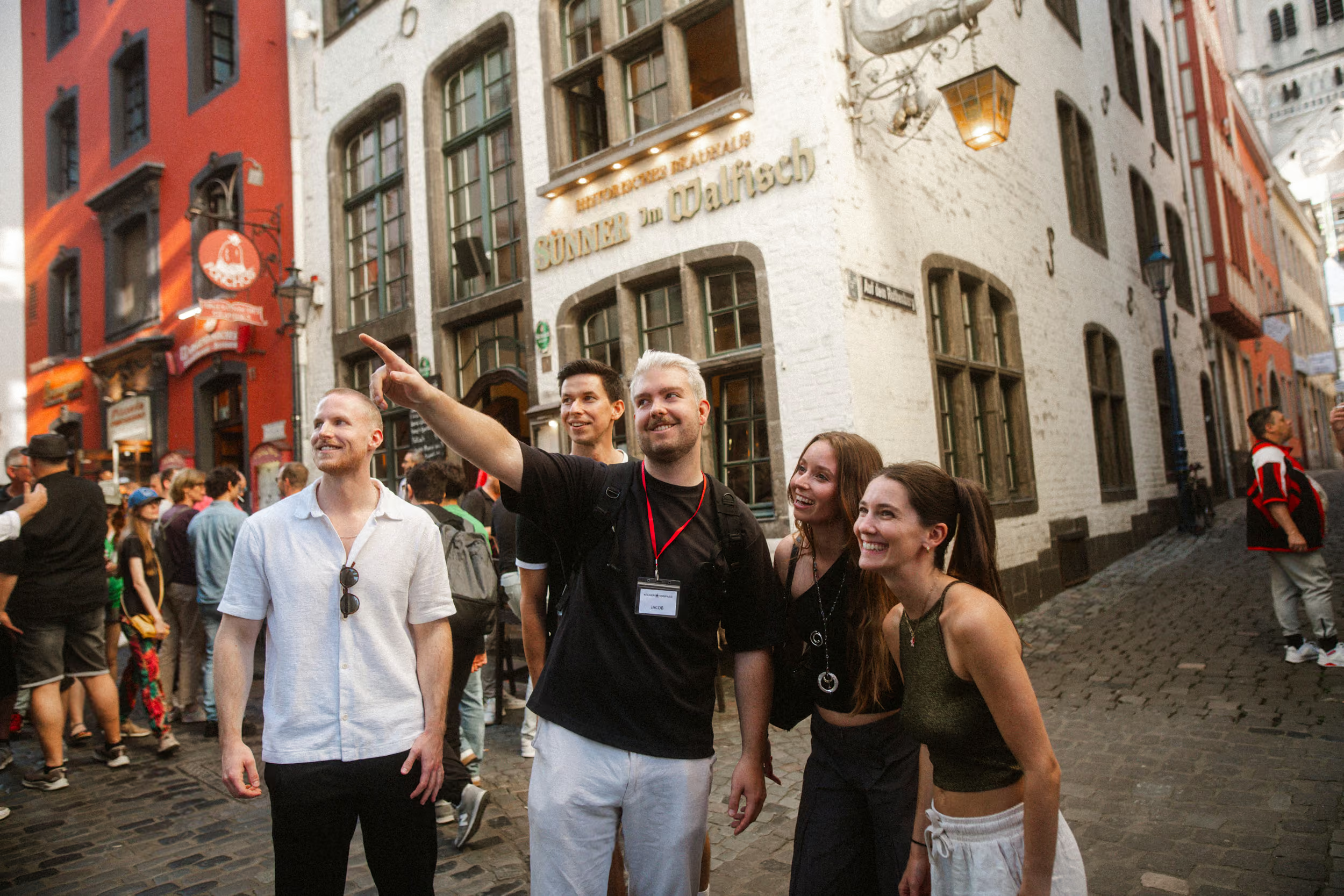
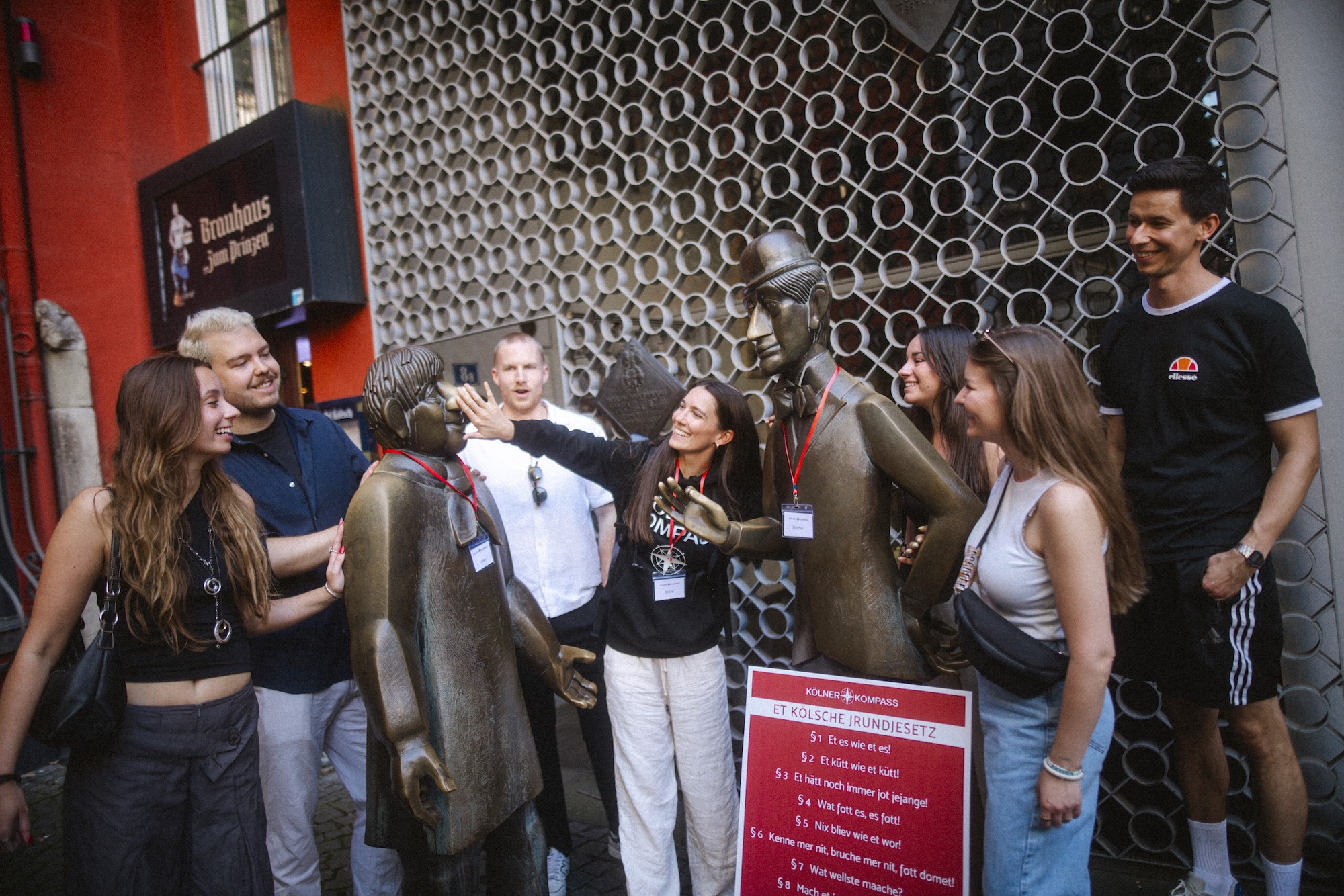
Today, their bronze figures are a popular photo stop in Cologne’s Old Town. We also pass Tünnes and Schäl on many of our brewery tours with Kölner Kompass. They are among the places our guests photograph most often and usually get a laugh as well. For us, stories like these belong on a good brewery tour just as much as a glass of Kölsch in a Brauhaus.

How long have Tünnes and Schäl been around?
Tünnes and Schäl have been part of the Hänneschen-Theater tradition since the 19th century. The theatre itself was founded by Johann Christoph Winters and dates back to 1802. Tünnes can be documented by name from at least 1839, while Schäl is generally placed around the middle of the 19th century.
The life-size bronze figures that many visitors know today arrived much later. On 30 April 1974, the bronze figures of Tünnes and Schäl created by sculptor Wolfgang Reuter were installed in Brigittengässchen during a street festival. As of 2026, they have been standing there for 52 years, watching countless Carnival seasons, group photos, people exploring the Kölner Brauhauswanderweg and other distinctly Cologne moments pass by.
It is particularly fitting that the two do not stand high above everyone on a pedestal. They are deliberately placed at ground level, quite literally keeping their feet on Cologne soil.
Were Tünnes and Schäl real people?
No. Tünnes and Schäl were not real people from Cologne. There are no historical biographies of two individuals on whom the characters can clearly be traced back. Instead, they are stage characters who exaggerate traits and behaviours that audiences would have recognised from everyday Cologne life.
There is, however, a long-standing story surrounding Schäl. According to the tradition, he was created as a caricature of a rival of the Hänneschen-Theater. We do know that such theatrical rivalry really existed. What cannot be proven is whether Schäl was actually created as a direct parody of one specific competitor.
So when Tünnes and Schäl are described today as true Cologne “originals”, that should not be taken too literally. They may be fictional, but Cologne stopped worrying about that distinction a long time ago.
What do the names Tünnes and Schäl mean?
Tünnes is a Rhineland form of the name Antonius, or Anton. The name was therefore not invented specifically for the theatre character. In the Rhineland, “Tünnes” could later also be used for someone considered a little simple or clumsy, although it is difficult to determine how much the famous character himself influenced that meaning.
There is even more wordplay behind the name Schäl. The Kölsch word “schäl” is related to the German word “scheel” and can mean more than simply cross-eyed or squinting. Depending on the context, it can also suggest something crooked, wrong, bad or unattractive. His name therefore describes more than just his appearance. The joke is already built into it.
It also happens to fit the Cologne expression “Schäl Sick”, the traditional name for the right bank of the Rhine. Whether that connection actually played a role when the character was named, or whether it became part of the story later, cannot be established with certainty.
Why do people rub Tünnes’ nose?
Rubbing Tünnes’ nose is said to bring good luck. Nobody, however, seems to know exactly where the tradition started. Neither the installation of the bronze figures nor later historical sources provide a clear origin for the custom. What is obvious is that the nose has been touched so often that it now shines noticeably brighter than the rest of the bronze.
At Kölner Kompass, we naturally take Cologne luck just seriously enough. On many of our brewery tours, we bring our guests past Tünnes and make sure they get their chance at a little extra luck. And if all it produces is a good group photo, the detour was still worth it.
Tünnes is not the only bronze figure to have developed this kind of ritual. Visitors also touch parts of New York’s famous Charging Bull in the hope of good luck and prosperity. In Bremen, touching the front legs of the donkey in the Town Musicians statue is likewise associated with luck. Apparently, some city icons eventually become too familiar simply to look at. People have to touch them.
What most people don’t know about Tünnes and Schäl
Tünnes and Schäl once turned out to be surprisingly effective fundraisers. In 1950, roughly four-metre-high wooden figures of the pair stood on Cologne’s Neumarkt. Anyone who donated towards rebuilding the Gürzenich, which had been destroyed during the war, was allowed to hammer a nail into the figures.
They were designed by sculptor Wolfgang Wallner and carved by students from the Kölner Werkschulen. Even Cologne’s mayor at the time, Robert Görlinger, took part and hammered in one of the first nails.
And if you would rather see Tünnes and Schäl somewhere other than as bronze figures in the Old Town, you can still visit the place where their story began. The Hänneschen-Theater continues to perform regularly, and depending on the programme, Tünnes and Schäl themselves still appear on stage.
You can also still come across the pair during Cologne Carnival. Where we last spotted a Tünnes and Schäl duo at a Carnival celebration in Cologne is something we would rather tell you over a Kölsch on one of our brewery tours.
Ready when you are!
We look forward to exploring historic breweries, hearing stories about Cologne, and enjoying freshly tapped Kölsch with you.

Related posts
What else is going on in Cologne!
Join the Tour