.svg)
Heinzelmännchen Fountain in Cologne: How to Read Its Story in Stone and What Visitors Often Miss

What is the Heinzelmännchen Fountain in Cologne?
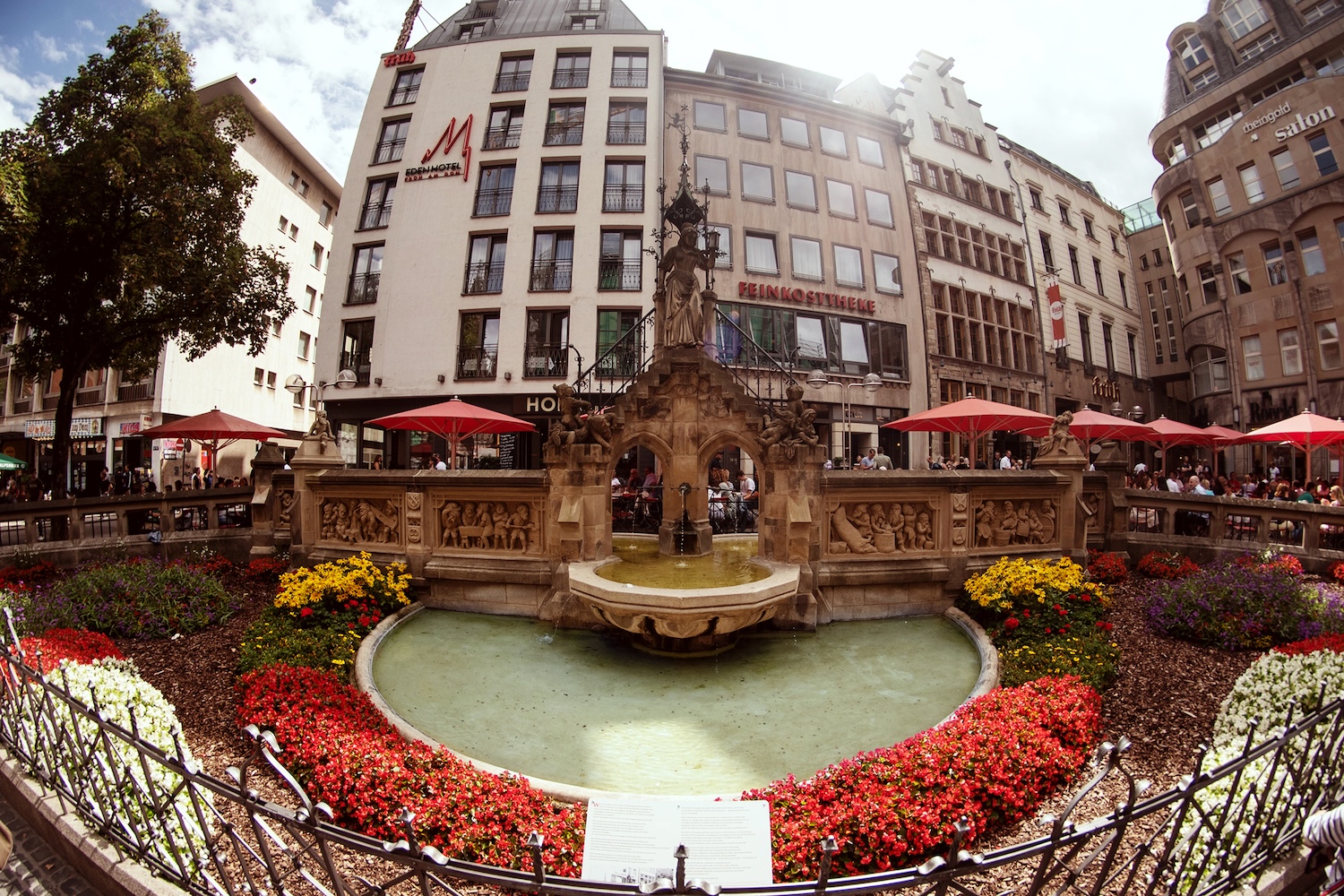
The Heinzelmännchen Fountain, often called the Pixies' Fountain in English, is a historic monument on Am Hof, just a few minutes' walk from Cologne Cathedral. Sculptor Edmund Renard and his son, the architect Heinrich Renard, created it between 1897 and 1900 as a stone retelling of the story of Cologne's Heinzelmännchen. Its main literary source was August Kopisch's 1836 ballad Die Heinzelmännchen zu Cölln.
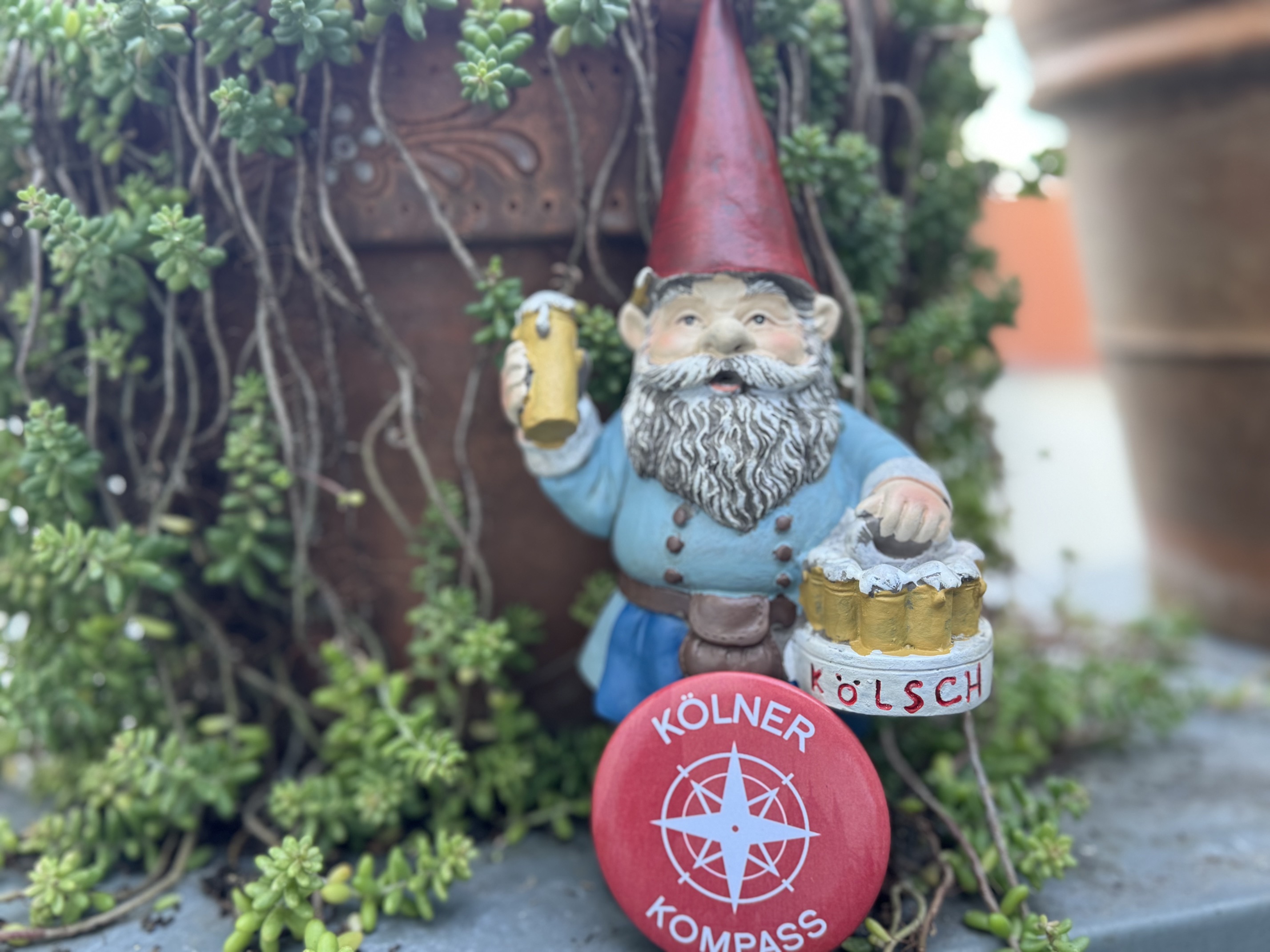
The Heinzelmännchen are small, helpful household spirits. According to Kopisch's version of the story, they secretly completed the work that Cologne's residents had left undone. That ended when a curious tailor's wife scattered peas on a staircase to catch sight of them. The Heinzelmännchen slipped, were discovered and disappeared from Cologne for good.
The tailor's wife stands at the centre of the fountain holding a lantern. Below her, the little helpers tumble down the steps. Relief panels on either side show the work they had previously done for carpenters, bakers, butchers, a cooper and a tailor.
The fountain is around 14 metres long and six metres high. Anyone who only photographs the tailor's wife will miss some of its best details. It is worth following the reliefs slowly and walking around to the back of the monument as well.
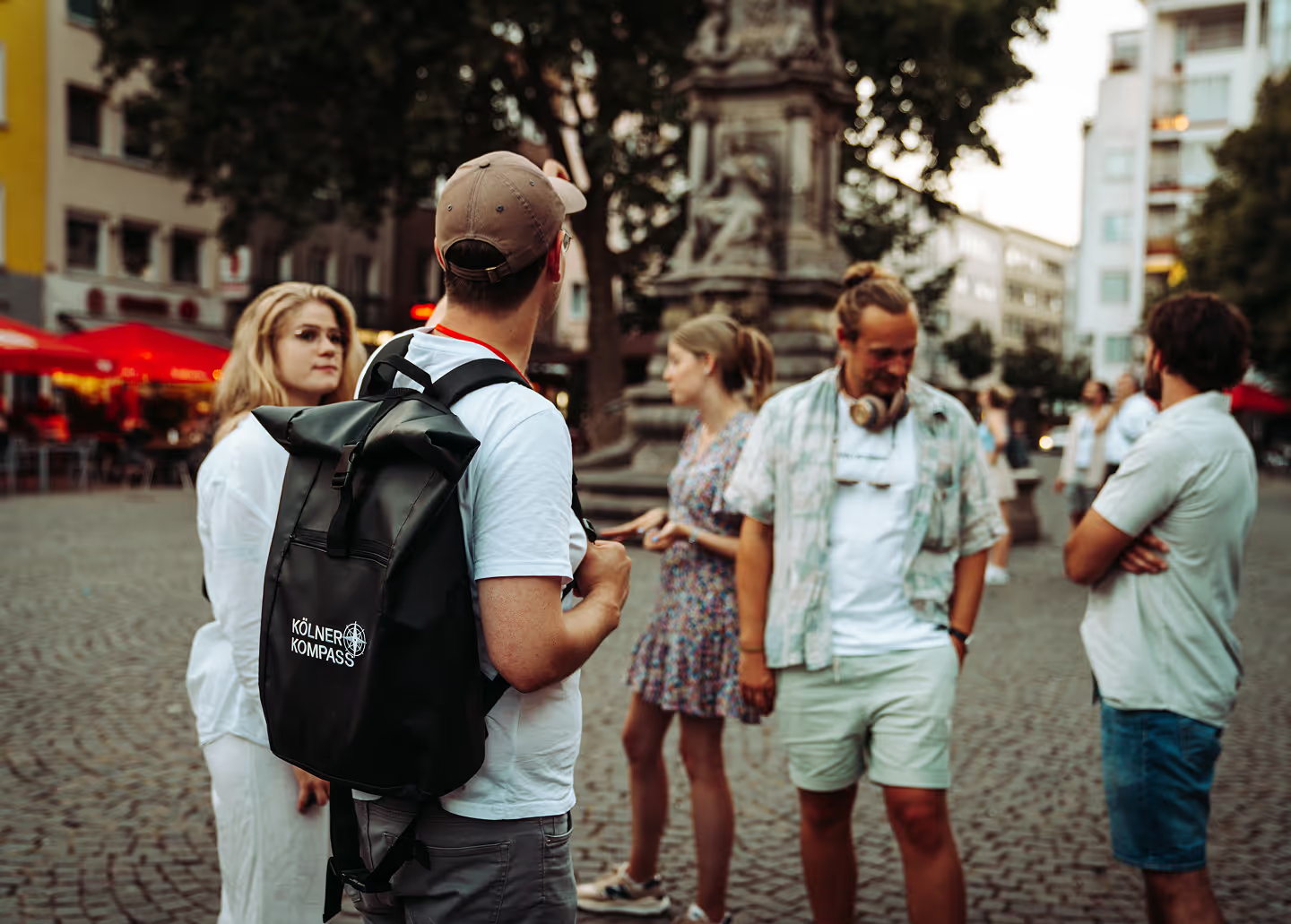
We often pass the Heinzelmännchen Fountain on our brewery tours through Cologne's Old Town. At first, it is simply a great place for a photo. Once the peas enter the story, however, it becomes one of those Cologne tales that tends to stay with people. Knowing the Heinzelmännchen also makes many other things around the city easier to understand. The little helpers appear in souvenir shops, company names, works of art and even on a Christmas market of their own. A story in which a few peas force an entire city to start working again is not easily forgotten.

What do the figures and reliefs show, and how do you read the story?
The Heinzelmännchen Fountain turns August Kopisch's 1836 ballad into a picture story carved in stone. Six pictorial reliefs show the Heinzelmännchen working in five trades: carpentry, baking, butchery, barrel making and tailoring. Two further panels contain shortened extracts from the first and final stanzas. The tailor's wife and the tumbling Heinzelmännchen in the centre form the climax of the story.
The fountain cannot be read quite as simply as a modern comic from left to right. Its different parts are spread across the monument. The story makes most sense if you look at it in four steps.
1. The story begins on the left text panel
The text panel on the left contains a shortened extract from the first stanza of Kopisch's ballad. It describes the comfortable days when the people of Cologne could leave their work unfinished because the Heinzelmännchen would arrive at night.
The well known opening reads:
„Wie war zu Köln es doch vordem
mit Heinzelmännchen so bequem!“
In plain English: life in Cologne used to be wonderfully easy when the Heinzelmännchen were around. The panel explains why the little helpers are shown working in the scenes that follow.
2. Six reliefs show the Heinzelmännchen at work
The six pictorial reliefs lead visitors through several workshops and trades:
Carpenters: The Heinzelmännchen work with chisels, axes and saws while preparing the beams of a house. This part of the story occupies two relief panels.
Baker: The little helpers carry heavy sacks, knead and weigh dough and put the bread into the oven.
Butcher: While the journeyman and apprentice sleep, the Heinzelmännchen process a pig and make sausages.
Cooper: A cooper is a craftsman who makes and repairs wooden barrels. Here the Heinzelmännchen take care of barrels and wine. Despite the famous Brauhaus directly opposite the fountain today, no beer is being brewed in this scene.
Tailor: The Heinzelmännchen cut, sew and embroider a ceremonial coat for Cologne's mayor.
The two carpentry scenes explain a small puzzle that becomes apparent when you count the panels. The fountain has six working reliefs but shows only five different trades.
3. The comfortable life ends in the centre
The central group shows the decisive moment in Kopisch's ballad. The tailor's wife stands above the steps with her lantern. Around her, seven fallen Heinzelmännchen can be counted. Some are already lying on the ground, while others are still trying to recover from the fall.
Directly below the tailor's wife is the inscription:
„Neugierig war des Schneiders Weib“
It means: "The tailor's wife was curious." The middle of the fountain is therefore more than its most striking group of figures. It captures the exact moment when the Heinzelmännchen are discovered and Cologne's comfortable days come to an end.
4. The right text panel reveals the ending
The text panel on the right contains a shortened extract from the final stanza. The Heinzelmännchen have disappeared, and the people of Cologne must once again do their own work.
The final line makes the consequence of the tailor's wife's curiosity perfectly clear:
„Man muß nun alles selber thun!“
In English: "Now everyone has to do everything themselves!"
The complete ballad is not inscribed on the fountain. There are eight side panels in total: six pictorial reliefs and two text panels. These are joined by the central group of figures and the inscription below the tailor's wife.
When was the Heinzelmännchen Fountain built, and who created it?
The Heinzelmännchen Fountain was developed between 1897 and 1900 by Cologne sculptor Edmund Renard and his son Heinrich Renard, an architect. Their proposal won a competition organised by the Cölner Verschönerungsverein, a local beautification society, in 1897. The formal commission followed in 1898, and the completed fountain was in place by early summer 1900.
Different websites and books give the years 1898, 1899 or 1900. We arranged the surviving evidence chronologically, and the apparent contradiction is easier to explain once the stages are separated:
- 1897: The Cölner Verschönerungsverein announced a competition for Cologne artists. Edmund and Heinrich Renard received first prize on 18 September.
- 1898: The winning proposal appeared in Greven's Adreßbuch, a Cologne address directory. On 16 November, the society formally commissioned the Renards to execute the design.
- 1899: The year marked the centenary of August Kopisch's birth. Preparatory work at the site began in November, and 1899 is also the year carved into the fountain's builders' inscription.
- 1900: The fountain was still nearing completion in late May. By the end of May and beginning of June, contemporary newspapers described it as newly erected.
The dates therefore refer to different stages between the competition and the completed monument. The Cölner Verschönerungsverein had the fountain built to commemorate the 100th anniversary of August Kopisch's birth. His ballad had made the Heinzelmännchen famous far beyond Cologne.
At the right end of the fountain, careful visitors can find the inscription:
„Erbauer E. und H. Renard 1899“
It identifies Edmund and Heinrich Renard as the creators and gives the year 1899. It does not, however, prove that the entire monument was finished that year. Contemporary newspaper reports show that the final work continued into 1900.
Heinrich Renard became particularly known for church architecture, while his father Edmund worked as a sculptor. The humorous, secular Heinzelmännchen Fountain was therefore an unusual joint project for father and son.
How much of the Heinzelmännchen Fountain is still original?
The Heinzelmännchen Fountain seen today is neither completely original nor a complete reconstruction. It combines historic stonework, restored elements, older replacements and more recent cast copies. The tailor's wife at the fountain is a copy. Much of the stair and rear wall structure appears to retain historic material, while the central inscription is generally identified as an original part.
The story of the tailor's wife is particularly remarkable. The original sandstone figure stood at the fountain until 1994 and weighs around 630 kilograms. It now belongs to the Kölnisches Stadtmuseum, the Cologne City Museum, where it is preserved as one of the museum's large historical objects.
The relief panels have a more complicated history. Panels were removed and replaced during different restoration campaigns, and some of the pieces taken down in 2017 and 2018 were already older copies. The most detailed publicly available restoration report records that relief and inscription panels were cleaned, strengthened and repaired, with cast replicas made in some cases. A complete public list identifying every current panel as an original, an older replacement or a new copy has not yet been found. Any simple percentage for the fountain's surviving original material would therefore be guesswork.
Weather was not the only reason so much work became necessary. A repair campaign between 1992 and 1994 failed to solve the sandstone's problems. A water repellent treatment applied to the reliefs was later judged unsuitable for the stone. According to the restorer responsible for the later campaign, the severe weathering that followed had not occurred during the previous eight decades. The treatment seems to have made the problem worse rather than protecting the monument.
The urgently needed restoration carried out in 2017 and 2018 was financed by the Cölner Hofbräu FRÜH brewery. Visitors to its Heinzelzauberbuden Christmas market stalls helped as well. According to the brewery, all proceeds from the stalls during the winter of 2017 and 2018 went towards the work. Anyone raising a Kölsch or mulled wine there was therefore practising a rather liquid form of monument conservation.
During the restoration, relief and inscription panels were removed, cleaned, consolidated and repaired. Cast copies were produced where required, damaged stonework was restored and the fountain basins were resealed. The result is not a newly built replica, but a historic monument with several material layers. Those layers now tell a second story: how difficult it is to preserve a delicate piece of Cologne outdoors for more than a century.
What do many visitors not know about the Heinzelmännchen Fountain?
Most visitors recognise the tailor's wife and the peas. It is much easier to overlook the owl on the back, the practical reason for the fountain's unusual shape and a relief that features wine rather than beer. In 2020, the fountain also made local headlines when its water suddenly turned blood red.
Why is there an owl with a magnifying glass on the back?
An owl sits on an open book at the back of the Heinzelmännchen Fountain and holds a magnifying glass in its claws. The group is commonly interpreted as a symbol of knowledge, wisdom and careful observation. So far, however, we have not found a surviving written explanation by Edmund or Heinrich Renard that confirms one single intended meaning.
The owl suits the fountain rather well all the same. Anyone who only photographs the tailor's wife and walks away will miss much of the story. This is a monument that rewards a closer look.
Was the Heinzelmännchen Fountain here before Früh am Dom?
Yes. The Heinzelmännchen Fountain was completed in 1900, while Früh am Dom opened at this location in 1904. A Cologne address directory from 1901 still lists the Central-Theater at Am Hof 12, where the famous Brauhaus would later operate.
The fountain's unusually wide shape also had a practical purpose. It was designed to conceal a rise in the street that was considered unattractive at the time. Before construction began, workers removed an old pump and filled in an existing well that was more than 15 metres deep. The Heinzelmännchen Fountain was therefore not only a monument. It was also a rather elaborate answer to a small urban planning problem.
Does any relief on the fountain have anything to do with beer?
Our favourite relief at the Heinzelmännchen Fountain does not show a brewer at all. It features a cooper who has fallen asleep while the Heinzelmännchen take care of his barrels and the wine stored in them. Kölsch is not brewed anywhere on the fountain.
On our brewery tours through Cologne's Old Town, we are naturally still allowed to be particularly fond of this relief. A sleeping craftsman, busy Heinzelmännchen and plenty of barrels make a very good Cologne story, even without Kölsch.
Why did red water suddenly flow through the fountain?
Red may be one of Cologne's city colours, but the blood red water that flowed through the Heinzelmännchen Fountain in July 2020 was not an official decoration. Animal rights activists had coloured the water as part of a protest against industrial livestock farming.
The campaigners said that twelve fountains in Cologne were affected. Police investigated possible property damage, and the city had water samples examined. Reports suggested food colouring or beetroot juice, but the substance used was not conclusively identified at the time.
The red colour disappeared again. For a short while, however, it looked as though the Heinzelmännchen had encountered a considerably bigger problem than a few peas.
When is the best time to visit the Heinzelmännchen Fountain?
The best time to visit the Heinzelmännchen Fountain is during daylight. That is when the six pictorial reliefs, the inscriptions and the owl on the back are easiest to see. The planted flower beds around the monument are also more attractive in daylight. Allow around ten to fifteen minutes if you want to examine the whole fountain rather than take one quick photograph.
The fountain is also worth seeing in the evening. After dark, it is illuminated, so the tailor's wife and the tumbling Heinzelmännchen remain clearly visible. That feels particularly appropriate because the Heinzelmännchen themselves only went to work after Cologne had gone to sleep. Daylight is still the better choice for the smaller details.
In winter, the fountain fits naturally into a walk through Cologne's Christmas markets. It is only a few minutes from the Christmas market at Cologne Cathedral. From there, visitors can continue to Heinzels Wintermärchen, the Christmas market on Alter Markt and Heumarkt. The little Cologne helpers appear not only in its name but throughout the market's design.
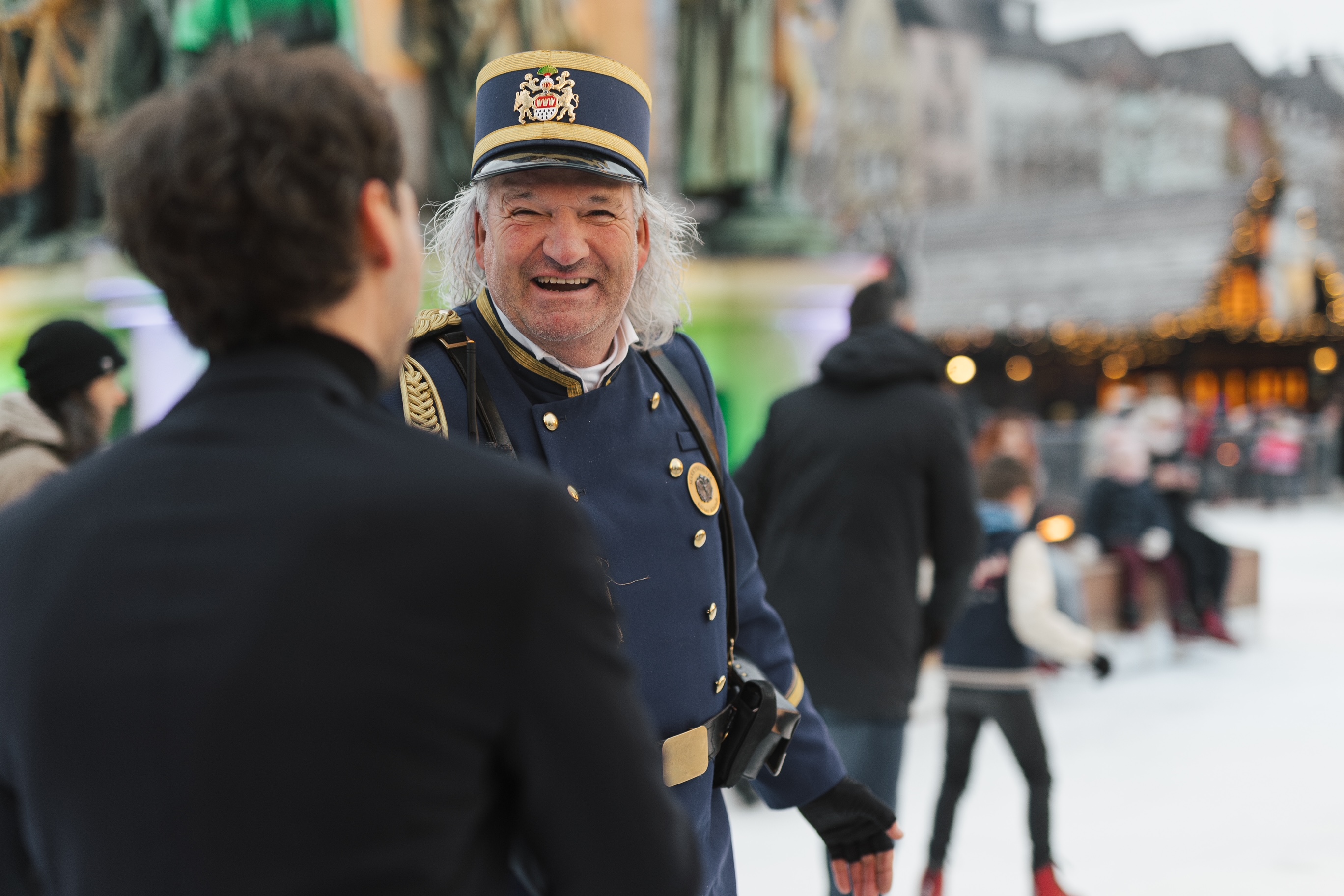
Of course, you can visit the Heinzelmännchen Fountain on your own. The story becomes even more enjoyable when someone shows you where to look and explains what is hidden in the different scenes. We often pass the fountain on our brewery tours through Cologne's Old Town. Along the way, the conversation goes far beyond the Heinzelmännchen. There is Kölsch, Brauhaus culture, lovable Cologne characters and more than a few stories that somehow seem to make even more sense after the second Kölsch.
Ready when you are!
We look forward to exploring historic breweries, hearing stories about Cologne, and enjoying freshly tapped Kölsch with you.
Related posts
What else is going on in Cologne!
Join the Tour